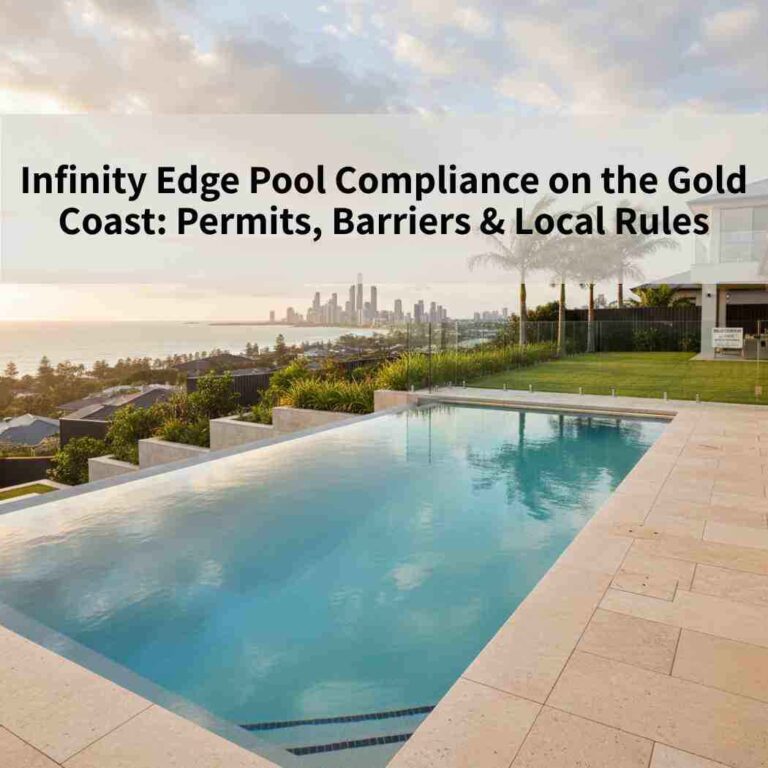
At Plunge Pools Gold Coast, we help homeowners design and build beautiful infinity edge pools that pass certification the first time. We work closely with engineers, certifiers, and inspectors so your pool looks perfect and meets the law.
In this article, you will learn how infinity-edge pool compliance works in practice. We will explain why these pools are treated as high risk, how siting and barriers affect approval, what local Queensland codes actually require, and where most homeowners run into trouble. By the end, you will understand how to make informed decisions before design and why early compliance planning is the key to getting an infinity edge pool approved the first time.
What Makes Infinity Edge Pools High-Risk?
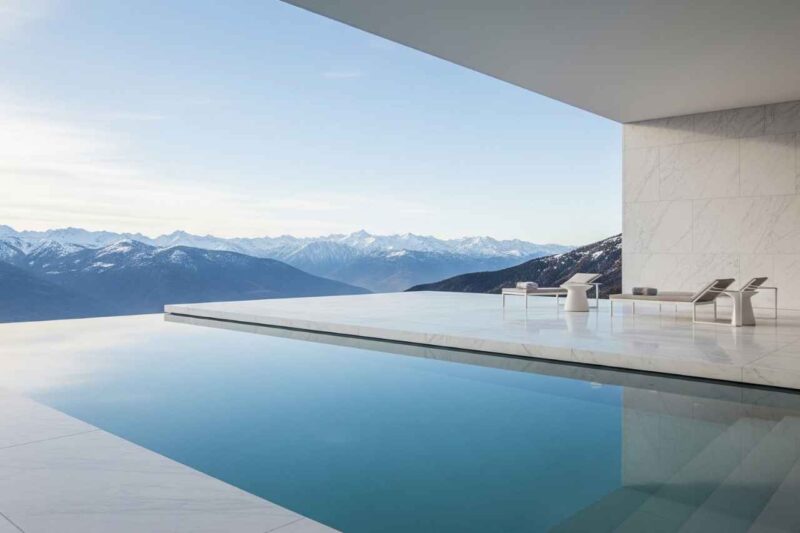
Infinity edge pools are classed as high-risk because they have exposed edges and hidden catch basins that create additional safety, structural, and compliance challenges compared to standard swimming pools.
Types of edge pools and why they matter
| Type of edge pool | How it works | Why it matters for compliance |
| Infinity edge pool | Water flows continuously over one wall into a concealed catch basin. | Creates a vertical drop and a second regulated water body that must be engineered, fenced, or otherwise made compliant. |
| Wet-edge pool | Water spills gently over a shallow lip into a narrow channel. | Lower visual drop but still requires checks for barrier proximity and water depth. |
| Vanishing edge pool | Water appears to disappear into the surrounding view, often on sloping sites. | Commonly hides a full secondary basin that is legally part of the swimming pool. |
While wet-edge pools may be easier to certify, infinity-edge and vanishing-edge pools attract far more scrutiny. In most cases, both the main pool and the catch basin are assessed as regulated swimming pools once depth thresholds are exceeded.
Quick tip:
Infinity edge pools are not banned in Australia. They simply demand precise planning, compliant engineering, and early involvement from a licensed building certifier to avoid costly redesigns and approval delays.
When is an Infinity Edge Pool Legally a “Swimming Pool”?
In Queensland, any structure that holds more than 300 mm of water is legally classified as a swimming pool, including the catch basin beneath an infinity edge pool.
- If it’s deeper than 300 mm → it needs fencing, approval, and registration.
- Catch basins count because they connect to the main pool.
- Calling a basin a “water feature” won’t avoid the rules.
Bottom line: If water is deep enough to stand in, it is a swimming pool in the eyes of Queensland law. For infinity edge pools, this means both the main pool and the catch basin must be designed, approved, and certified as regulated pools from day one.
What Approvals are Needed Before Building?
Before construction begins, three approvals are mandatory: building approval, engineering sign-off, and pool registration. These approvals ensure your infinity edge pool meets Queensland building laws, structural safety standards, and pool safety regulations before any work starts.
1. Building Approval
Handled by: Private building certifier
A building approval confirms that the infinity edge pool design complies with Queensland building legislation, local council siting rules, and pool safety barrier requirements. For infinity edge pools, certifiers closely assess edge walls, catch basin layouts, barrier locations, and non-climbable zones because these pools present higher compliance risks than standard pools.
Without a valid building approval, construction cannot legally commence, and rectification costs later can be high.
2. Engineering Sign-Off
Handled by: Structural and hydraulic engineers
Engineering sign-off verifies that the pool is safe, stable, and fit for its site conditions. Structural engineers assess edge wall strength, footing design, soil classification, and loads created by the water mass and exposed edge. Hydraulic engineers confirm overflow rates, catch basin capacity, surge volume, and drainage performance to prevent flooding or pump failure.
This step is critical for infinity edge pools, particularly on sloping or elevated sites where soil stability and water control directly affect long-term safety.
3. Pool Registration
Handled by: Queensland Building and Construction Commission (QBCC)
All regulated pools in Queensland must be registered with the QBCC. Registration links the infinity edge pool, including its catch basin, to future inspections, compliance certificates, and safety records. Registration is required before final certification and is essential for property sale, lease, or insurance.
Failing to register can delay certification and expose homeowners to fines or compliance notices.
Why Early Approval Matters
Infinity edge pools involve dual water bodies, exposed edges, and complex hydraulics. Delays or errors in approvals often occur when certification and engineering are treated as afterthoughts rather than part of the initial design process.
Because approvals depend on design and hydraulics, infinity edge pool design and installation requirements should be understood before plans are submitted.
Plunge Pools Gold Coast works with private certifiers, structural engineers, and hydraulic engineers from day one, streamlining approvals and reducing the risk of redesigns, construction delays, or failed inspections. This integrated approach ensures your infinity edge pool is approved, built, and certified correctly the first time.
Why Barrier Rules Often Clash with Infinity Designs
Barrier rules often clash with infinity edge pool designs because open views reduce effective barrier height, while Queensland pool laws prioritise child safety over aesthetics. As a result, many infinity edge pools fail inspection even when the pool itself is structurally sound.
Common reasons fences fail
- The edge wall isn’t tall enough to count as a barrier.
- The fence loses height when the water level is high.
- Gate latches, or gaps, don’t meet the Queensland code
How Compliant Infinity Designs Are Achieved
The most successful infinity-edge pool projects integrate compliant barriers into the architecture from the outset. This may include raised-edge walls designed to meet barrier-height requirements, stepped landscaping outside the non-climbable zone, concealed fencing solutions, or adjusted pool siting to maintain views while meeting code.
Plunge Pools Gold Coast designs infinity edge pools with barrier compliance built in from day one, working alongside private certifiers to ensure fencing, edge heights, and access points pass inspection without sacrificing safety or approvals.
Early planning is the difference between an infinity edge pool that looks exceptional and one that cannot be legally certified.
What Is a Non-Climbable Zone Under Queensland Pool Safety Laws?
A non-climbable zone is a 900 mm clear space around a pool fence that must be kept free of anything a child could use to climb over the barrier.
Key rules to remember:
- The rule applies to both sides of the fence
- No steps, furniture, planter boxes, trees, or structures are allowed within this zone
- Landscaping must be kept trimmed at all times
- Compliance is ongoing, not just at inspection time
Even after certification, moving a pot plant or adding furniture too close to the fence can make your pool non-compliant under Queensland law.
Tip: Take photos after your pool safety inspection so you have a clear reference of the compliant layout.
Catch Basins & Balance Tanks: Why These Areas Commonly Fail Approval
Catch basins can quietly fail your approval if they’re deep, open, or easy to reach.
A basin needs its own fence if:
- It’s deeper than 300 mm and accessible, or
- You can lean or step into it from a nearby surface.
Inspectors check:
- Vertical drop from decks or coping to water.
- Horizontal distance to the edge.
- Effective barrier height (measured from the highest point nearby).
Because many basins sit below the main pool, they’re easy to overlook. Design them for safety from the start.
State-by-State Rules: Why QLD Standards Are Unique
Every state has different pool laws. On the Gold Coast, Queensland rules always apply, even if a design passed in NSW or Victoria.
| State | Key Law | Why It’s Different |
| Queensland | Building Act 1975 + QDC MP 3.4 | Certifiers and pool safety inspectors enforce tight rules. |
| New South Wales | Swimming Pools Act 1992 | Uses different inspection classes (E1, A1, A2). |
| Victoria | Building Regulations 2018 + AS 1926.1 | Barrier heights are similar, but enforcement is softer. |
Always design to Queensland law; what passes elsewhere can fail here.
Performance-Based Solutions (and When They Don’t Work)
Sometimes a standard fence doesn’t suit an infinity edge view. In those cases, designers may use a performance solution, an engineered alternative that proves equal safety.
You’ll need:
- Evidence from an engineer or safety consultant.
- Fixed, permanent materials (no movable glass).
- Certifier approval before building.
Performance solutions look smart, but can cause future headaches if plants grow or furniture changes the layout.
Most homeowners get faster approval by adjusting the design instead.
Exemptions & Variations
Exemptions are rare. They’re only accepted for:
- Disability access needs, or
- Proven site limits (like extreme slope).
You can’t claim an exemption for cost, view, or design preference. Even with approval, you must still keep the pool as safe as possible.
If a builder suggests “just apply for an exemption,” get a second opinion first.
Final Inspection, Certification & Ongoing Care
Approval doesn’t end when the pool is built; it’s the start of ongoing responsibility.
What happens after construction
- Final inspection – certifier checks pool, gates, and basin.
- Safety certificate issued – confirms compliance.
- Registration – recorded with QBCC.
- Maintenance – keep fences and zones clear.
Certificates expire when you sell or lease the home, so new owners may need recertification.
If something changes, like new landscaping or glass panels, you must make sure the pool still complies.
Common Compliance Mistakes (and How to Avoid Them)
| Mistake | Why It Happens | Costly Result |
| Design approved but not certifiable | Barriers are not checked early | Pool built, butit can’t be used |
| Hidden catch basin unfenced | Basin depth ignored | Expensive retro-fencing |
| Wrong edge height | Water level not allowed for | Barrier too short |
| Landscaping too close | Plants or pots break the 900 mm rule | Rework before final sign-off |
| Non-certified glass | Wrong materials or fittings | Whole fence replaced |
Many approval shortcuts create issues later, which is why understanding what happens after the first year of owning an infinity edge pool helps homeowners spot problems early.
How to Get Infinity Edge Pool Approval Right the First Time
Follow these steps to make compliance simple:
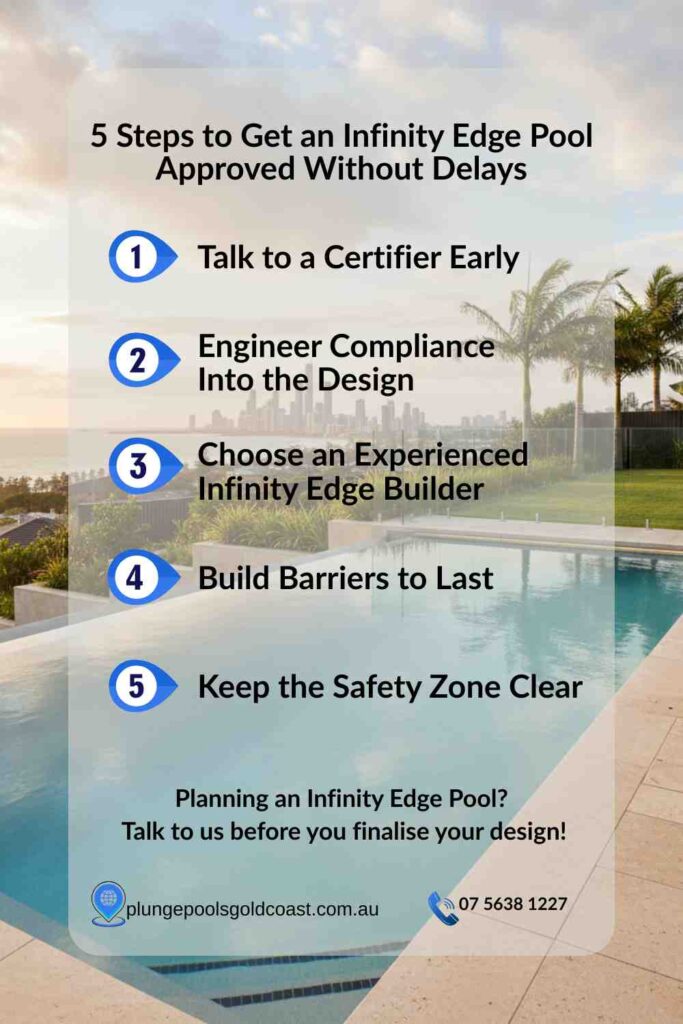
Quick checklist
| Step | Who Helps | Goal |
| Design review | Builder + certifier | Spot risks early |
| Engineering | Structural + hydraulic engineer | Safe walls and basins |
| Barrier planning | Certifier | Fence and gate compliance |
| Final inspection | Pool safety inspector | Receive certificate |
Conclusion
Infinity edge pools are not prohibited on the Gold Coast. They are achievable when compliance is treated as part of the design, not as a finishing step. The challenge is not the pool itself, but the assumption that approval can be resolved later.
At Plunge Pools Gold Coast, we design and build infinity edge pools with compliance built in. If you’re planning a pool and want it approved, certified, and ready to enjoy, our team can guide you through every step from first sketch to final swim.
FAQs
1. Do infinity edge pools require different permits and approvals than standard pools on the Gold Coast?
Yes. Infinity edge pools require stricter permits and approvals than standard pools on the Gold Coast. Their exposed edges and catch basins trigger additional building approval checks, engineering documentation, and pool safety assessments under Queensland law.
2. Why do infinity edge pool designs often fail barrier and fencing compliance?
Infinity edge pool designs fail barrier compliance because walls and edges rarely meet legal barrier height and non-climbable zone rules. Visual openness reduces effective barrier height, causing designs that look safe to fail measurement during inspection.
3. Is a catch basin legally considered part of the swimming pool in Queensland?
Yes. In Queensland, a catch basin is legally part of the swimming pool if it can hold water deeper than 300 millimetres. Because it is accessible and hydraulically connected, it must meet full pool safety and barrier requirements.
4. Can an infinity edge pool be built on the Gold Coast without ruining the view and still meet pool safety laws?
Yes. An infinity edge pool can meet Gold Coast pool safety laws without ruining the view if barriers, glass, and non-climbable zones are designed into the structure from the start rather than added after construction.
5. What should be checked before designing an infinity edge pool to avoid certification delays?
Before design begins, barrier locations, non-climbable zones, catch basin access, edge heights, and certifier requirements must be checked. These early decisions determine whether the pool can be certified or delayed after construction.